
Stem cell therapy for shoulder pain and rotator cuff tears: what the evidence shows
Shoulder pain is one of the most common reasons people seek orthopaedic care, and rotator cuff disease accounts for the majority of cases. For many patients, the journey follows a familiar pattern: physiotherapy for months, one or two corticosteroid injections, an MRI that confirms a partial or full-thickness tear, and then a conversation about surgery that they are not ready to have.
It is at this point — after conservative treatment has reached its limit but before a decision about surgery becomes unavoidable — that regenerative medicine is increasingly relevant. This article covers what stem cell therapy actually does for shoulder pathology, what the evidence supports and where it falls short, and what the treatment involves at a physician-led clinic in Bangkok.
What is rotator cuff disease and why is it difficult to treat?
The rotator cuff is a group of four muscles and tendons that stabilise the shoulder and enable overhead movement. Rotator cuff disease covers a spectrum — from tendinopathy, where the tendon is inflamed and degenerating but intact, to partial and full-thickness tears where it is physically disrupted.
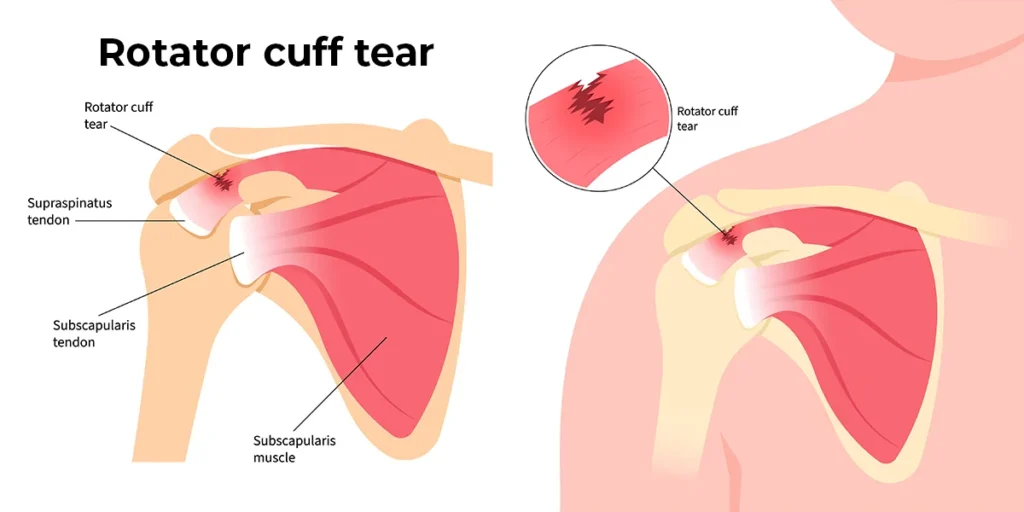
Photo courtesy of atriumhealthfloydharbin
The core problem is biological. Tendons heal poorly because they have limited blood supply and low cellular turnover. Once degenerating or torn, the repair process is slow and tends to produce inferior scar tissue rather than organised tendon. This is why physiotherapy and anti-inflammatory treatment manage symptoms but rarely reverse the structural problem — and why surgical repair, while corrective, still carries a meaningful retear rate, particularly in older patients.
Rotator cuff disease is strongly age-related, with full-thickness tears becoming significantly more common after 50.
How does stem cell therapy work for the shoulder?
UC-MSCs — Umbilical Cord-Derived Mesenchymal Stem Cells— act primarily through paracrine signalling rather than by directly differentiating into new tendon tissue. When injected into or around the affected tendon, they release signalling molecules that do three things relevant to rotator cuff pathology:
Reduce local inflammation
The chronic inflammatory environment in a degenerating tendon perpetuates damage and impairs healing. UC-MSCs release anti-inflammatory cytokines that modulate this environment, reducing the signals that drive ongoing tissue breakdown.
Stimulate tissue repair
MSCs secrete growth factors that support tenocyte (tendon cell) activity and promote the production of organised collagen — the structural protein that gives tendons their mechanical strength. This is the mechanism through which stem cell therapy may improve tendon quality rather than simply masking pain.
Support the tendon-to-bone interface
Rotator cuff tears almost always happen at the point where tendon meets bone. It is also where surgical repairs are most likely to fail. UC-MSCs release signals that appear to strengthen the healing process at exactly this junction — which may explain the reduction in retear rates seen in studies.
What does the clinical evidence show?
The evidence for stem cell therapy in rotator cuff disease is growing, broadly positive, and still developing.
MSC therapy is consistently safe and well-tolerated, with no significant adverse events reported across multiple studies. Where the evidence is strongest is in tendon healing — patients who received stem cell therapy alongside surgical repair showed meaningful reductions in retear rates, suggesting the cells support more durable healing at the tendon-bone interface, not just symptom relief.
For non-surgical patients with tendinopathy or partial tears, results are more variable. Patient selection appears to be a significant factor in outcome, and the research here is still catching up.
Stem cell therapy for the shoulder is not a guaranteed fix. What it offers is a biologically meaningful intervention that targets the underlying tissue environment — with a safety profile that compares favourably to surgical alternatives.
Who is a good candidate?
Not everyone with shoulder pain is appropriate for stem cell therapy, and the clinical picture requires careful assessment before any recommendation is made.
The patients most likely to benefit are those with degenerative rotator cuff tendinopathy or partial-thickness tears who have not responded adequately to six or more months of physiotherapy, have not had sustained benefit from corticosteroid injections, and are not yet at a stage requiring surgical repair. Imaging — typically MRI — is essential to confirm the extent of tendon involvement, rule out full-thickness tears that have retracted significantly, and identify any coexisting pathology such as glenohumeral arthritis or biceps tendon involvement.
Full-thickness tears with significant retraction are generally not appropriate for injection-based stem cell therapy alone — the structural gap is too large for biological signalling to bridge without surgical repair. Patients in this category are better served by a surgical consultation, at which point MSC augmentation at the time of repair is a relevant conversation.
Patients with active infection, recent corticosteroid injection within six weeks, or certain systemic conditions require further evaluation before treatment is considered.
What does treatment involve at EDNA Wellness?
At EDNA Wellness, shoulder cases are assessed by orthopaedic surgeons with imaging review before any treatment decision is made. Stem cell therapy is not recommended to every patient who presents with shoulder pain — the clinical picture has to support it.
Where treatment is indicated, UC-MSCs sourced from a TISTR-certified GMP laboratory are prepared fresh and administered within 24 hours of preparation to maintain cell viability. Delivery is by ultrasound-guided injection to the target site — the tendon, the peritendinous space, or the tendon-bone interface depending on the specific pathology. A Certificate of Analysis documenting cell count, viability, and sterility is provided for every batch used.
Post-treatment, most patients are advised to avoid heavy overhead loading for two to four weeks while the biological response develops. Physiotherapy is typically continued alongside treatment to support shoulder mechanics and muscle function.
Medically reviewed by Dr. Naputt Virasathienpornkul, M.D. Orthopedic Surgeon, Sports Medicine & Joint Conditions
About EDNA Wellness
EDNA Wellness is a surgeon-led regenerative medicine center in Bangkok, specializing in orthopedic and neurological conditions using Umbilical Cord–Derived Mesenchymal Stem Cells (UC-MSCs).
All cases are reviewed by orthopedic surgeons and neurosurgeons, with a focus on clinical indication, patient safety, and realistic treatment expectations. Stem cell therapy is recommended selectively, and alternative treatments are considered when more appropriate.
For more information or to book a consultation
LINE: @ednawellness
WhatsApp: +66 (0) 64 505 5599
References
- Liang W, Zhou C, Deng Y, et al. Stem cell-based therapeutic strategies for rotator cuff tendinopathy. Annals of Medicine. 2024;56(1):2337871. https://pubmed.ncbi.nlm.nih.gov/38738394/
- Ferreira NV, Andrade R, Freitas TP, et al. The role of injections of mesenchymal stem cells as an augmentation tool in rotator cuff repair: a systematic review. JSES Reviews, Reports, and Techniques. 2025;5(2):231–242. https://pubmed.ncbi.nlm.nih.gov/40321851/
- Kim SJ, Kim EK, Kim SJ, Song DH. A randomized controlled trial of stem cell injection for tendon tear. Scientific Reports. 2022;12(1):1300. https://pubmed.ncbi.nlm.nih.gov/35039529/
- Wang HN, Rong X, Yang LM, Hua WZ, Ni GX. Advances in stem cell therapies for rotator cuff injuries. Frontiers in Bioengineering and Biotechnology. 2022;10:866195. https://pmc.ncbi.nlm.nih.gov/articles/PMC9174670/