An ACL tear is one of the most feared injuries in sports, often sidelining athletes for months and sometimes even ending careers
But it’s not just professional athletes who are at risk. Anyone with an active lifestyle can suffer an ACL injury. Understanding what an ACL injury is, how it happens, and the modern treatments available including cutting-edge regenerative medicine is crucial for a successful recovery
What Is an ACL Injury?
The anterior cruciate ligament (ACL) is a crucial band of tissue in the center of your knee that connects your thigh bone (femur) to your shin bone (tibia). Its primary job is to provide rotational stability and prevent the tibia from sliding forward excessively.
An ACL injury, or tear occurs when this ligament is stretched beyond its limits or completely torn. These injuries are graded from I to III, with a Grade III tear representing a complete rupture.
Causes and Risk Factors
ACL injuries typically result from sudden, high-impact movements. Common causes and risk factors include:
- Sudden stops or changes in direction: This is a common mechanism in sports like soccer, basketball, and football.
- Awkward landings from a jump: A common cause in volleyball and gymnastics.
- Direct impact to the knee: A hard tackle in football or a skiing accident can cause an ACL tear.
- Overuse and poor biomechanics: While less common than acute tears, repetitive stress and improper form can weaken the knee and increase the risk of injury.
- Gender: Female athletes are at a higher risk of ACL tears due to anatomical and hormonal differences, as well as neuromuscular control variations.
(Source: Mayo Clinic)
Symptoms of an ACL Tear
Recognizing the symptoms of an ACL tear is key to getting a prompt diagnosis and treatment. The most common signs include:
- A loud “pop” sound or sensation in the knee at the moment of injury.
- Severe pain and the inability to continue the activity.
- Rapid swelling within the first few hours.
- Loss of range of motion.
- Knee instability, or the feeling that your knee is “giving way.”
(Source: Mayo Clinic)
Current Treatment Options
Following a clinical diagnosis, which may include an MRI, treatment plans are tailored to the individual’s age, activity level, and the severity of the tear.
- Non-Surgical Management: For some individuals with partial tears, particularly those with a less active lifestyle, treatment may involve physiotherapy to strengthen the surrounding muscles, bracing to provide support, and rest.
- ACL Reconstruction Surgery: This is the standard of care for athletes and active individuals with a complete tear. During the procedure, the torn ligament is replaced with a graft, often taken from another part of the patient’s body (autograft) or a donor (allograft)
Role of Regenerative Medicine
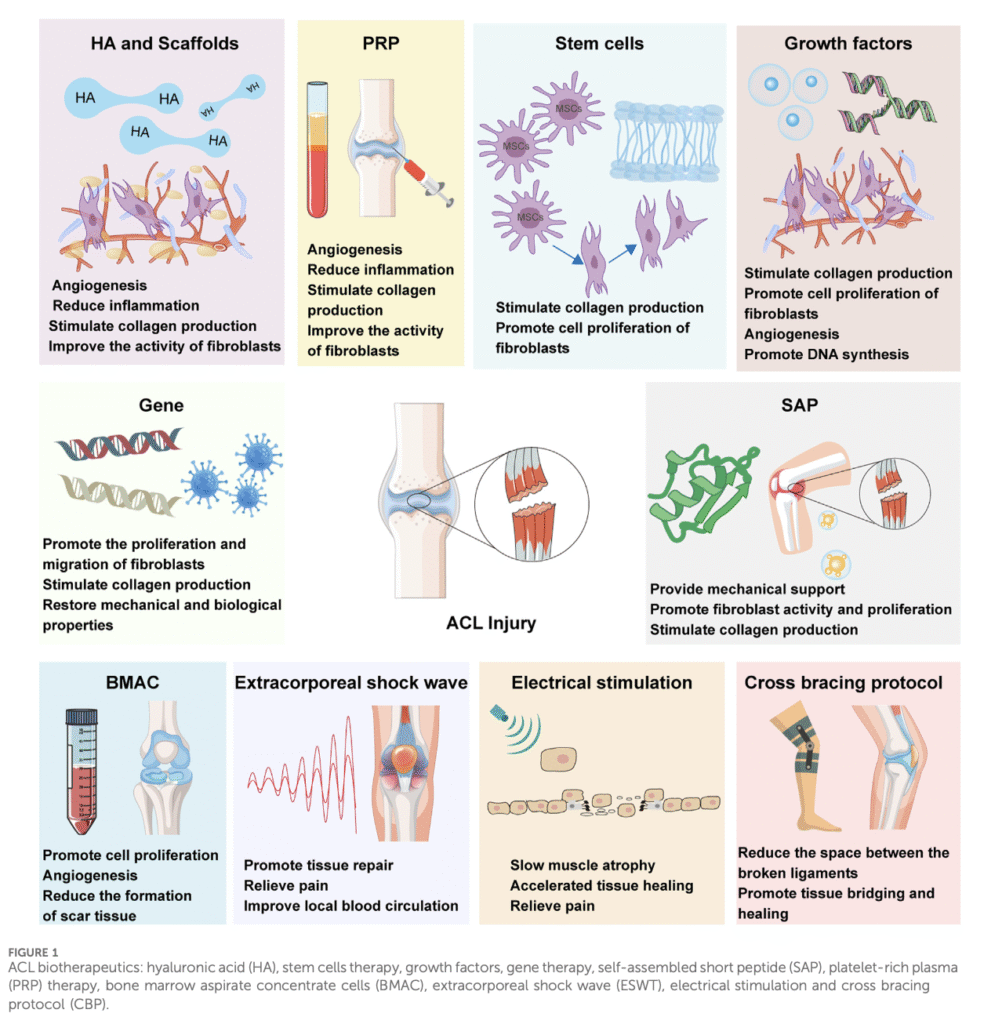
The field of regenerative medicine offers promising new avenues for treating ACL injuries. These therapies aim to enhance the body’s natural healing processes, potentially leading to faster recovery and better long-term outcomes.
Platelet-Rich Plasma (PRP) and stem cell therapy are two leading regenerative treatments being studied for ACL injuries. PRP is made from a patient’s own blood and contains a concentrated amount of growth factors that can stimulate tissue repair. Stem cells, which have the remarkable ability to differentiate into various cell types, are being explored for their potential to help regenerate the torn ligament itself.
A comprehensive review published in Frontiers in Medicine titled “ACL Injury Management: A Comprehensive Review of Novel Biotherapeutics” highlights the potential of these treatments. The authors note that while these therapies are still largely considered investigational, studies show they may reduce inflammation, promote healing, and improve outcomes when used as an adjunct to traditional surgery or even as a standalone treatment for certain types of partial tears.

FAQs
Can ACL tears heal naturally?
Generally, a complete ACL tear cannot heal on its own because of its poor blood supply and the constant motion within the knee joint. The ends of the torn ligament do not typically reconnect, which is why surgical intervention is often necessary for those who want to return to high-level activities.
How long is ACL recovery?
Recovery time for an ACL tear, especially following surgery, is a lengthy process. A typical timeline for a return to sports can range from 6 to 12 months, depending on the individual’s dedication to physical therapy and the complexity of the injury. Initial recovery focuses on reducing swelling and regaining range of motion, followed by strengthening and, finally, sports-specific training.
Are stem cells a proven option for ACL?
While stem cell therapy for ACL repair shows great promise, it is not yet considered a standard, proven treatment. It is currently an area of active research.
Most reputable clinics and institutions offer it within the context of clinical trials or as a non-standard treatment for specific, often chronic, conditions. Patients should consult with a specialized orthopedic physician to understand if they are a candidate for such therapies and what the risks and benefits are.
An ACL injury doesn’t have to be a career-ending event. With a proactive approach to diagnosis, personalized treatment, and diligent rehabilitation, a full return to an active lifestyle is possible.
Modern medicine, including surgical advancements and the emerging field of regenerative therapies like ACL stem cell therapy Bangkok, offers more options than ever before. Whether you’re an athlete considering ACL tear treatment Thailand or an active individual, understanding your options is the first step toward a successful recovery
About EDNA Wellness
EDNA Wellnessis a private clinic specializing in Stem Cell Therapy in Bangkok, Thailand for Neurology & Stroke as well as Bones & Joints. Beyond rehabilitation, we also provide aesthetic and wellness treatments to support your full-body vitality. All delivered with expert care and compassion
For more information or inquiries, contact us via
LINE @ednawellness
WhatsApp +66 (0) 64 505 5599
References:
- Mayo Clinic. (2023). ACL injury. Retrieved from https://www.mayoclinic.org/diseases-conditions/acl-injury/symptoms-causes/syc-20350738
- National Institutes of Health (NIH). (2023). Anterior cruciate ligament (ACL) injury. Retrieved from https://medlineplus.gov/ency/article/001074.htm
- Yu, X., Hu, J., Li, Y., Wen, Y., & Li, B. (2024). ACL injury management: a comprehensive review of novel biotherapeutics. Frontiers in Bioengineering and Biotechnology, 12, 1455225. Retrieved from https://www.frontiersin.org/journals/bioengineering-and-biotechnology/articles/10.3389/fbioe.2024.1455225/full
- Cleveland Clinic. (2023). ACL Tear & Injury: Symptoms & Recovery. Retrieved from https://my.clevelandclinic.org/health/diseases/16576-acl-tear